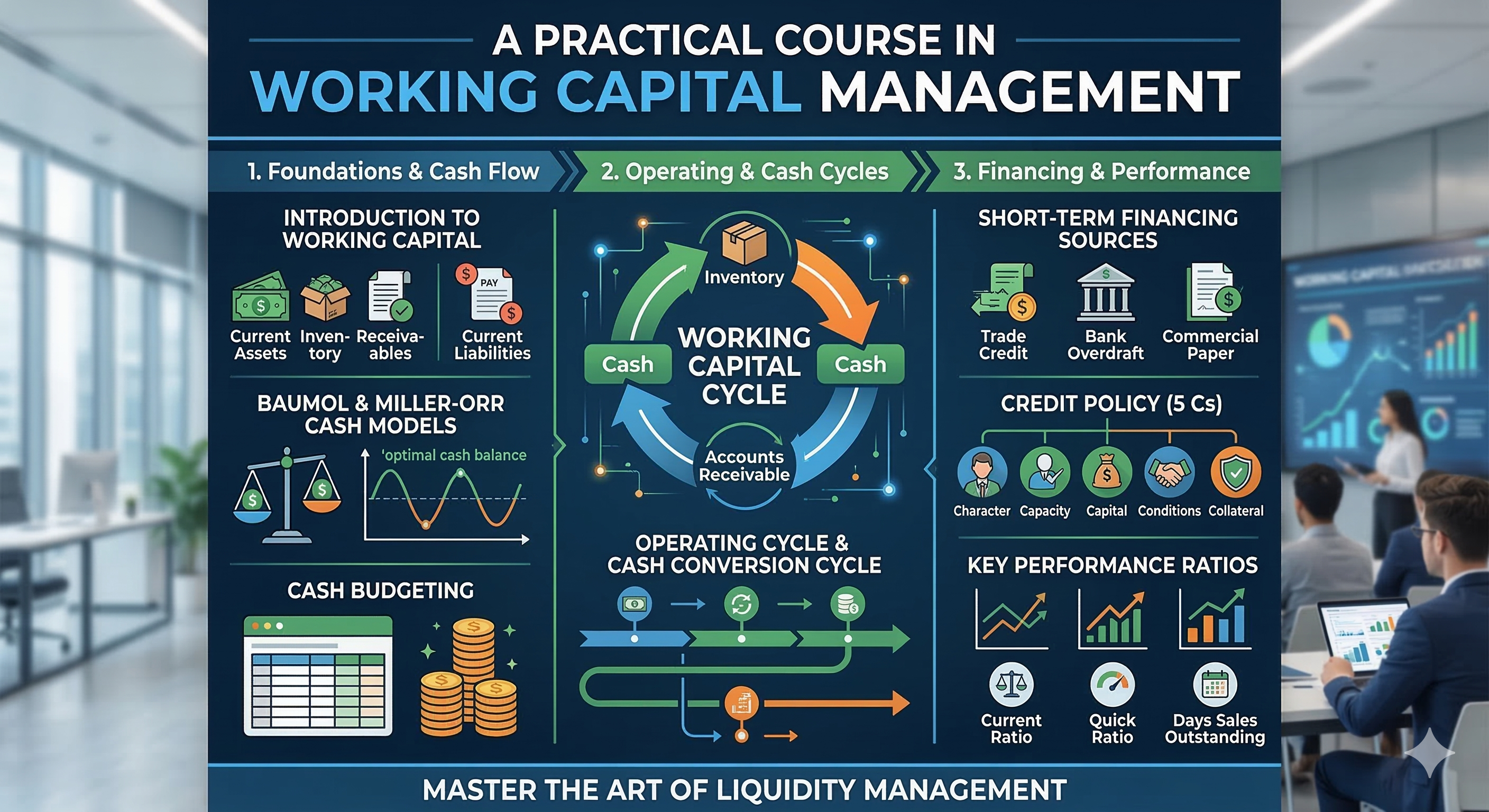
Course Overview: Working Capital Management
Course Code: BC1204
Credits: 4 | Duration: 12 Weeks
Course Objective: To provide students with a theoretical and practical understanding of managing short-term assets and liabilities to ensure an organization’s liquidity and operational efficiency.
Weekly Content Breakdown
Phase 1: Foundations & Strategy
- Week 1: Introduction to Working Capital
- Concepts of Gross and Net Working Capital.
- The Risk-Return Trade-off (Liquidity vs. Profitability).
- Determinants of Working Capital requirements.
- Week 2: Operating and Cash Cycles
- Calculating the Operating Cycle and Cash Conversion Cycle (CCC).
- Strategies to shorten the CCC.
- Impact of inflation and business cycles on WCM.
- Week 3: Working Capital Policy
- Aggressive, Conservative, and Matching (Hedging) approaches.
- Forecasting working capital needs: Percent of Sales and Operating Cycle methods.
Phase 2: Asset Management
- Week 4: Cash Management Models
- Motives for holding cash.
- Baumol Model (Inventory approach to cash).
- Miller-Orr Model (Stochastic approach).
- Week 5: Cash Budgeting and Concentration
- Preparing Monthly/Quarterly Cash Budgets.
- Techniques for accelerating collections (Lockbox systems, Concentration banking).
- Management of disbursements.
- Week 6: Receivables Management (Credit Policy)
- The "5 Cs" of Credit.
- Credit standards, terms, and collection policies.
- Analyzing the impact of credit policy changes.
- Week 7: Receivables Monitoring & Factoring
- Aging schedules and Days Sales Outstanding (DSO).
- Introduction to Factoring and Forfaiting.
- Securitization of receivables.
- Week 8: Inventory Management Foundations
- Types of inventory and associated costs (Holding, Ordering, Shortage).
- Economic Order Quantity (EOQ) model with and without discounts.
- ABC Analysis and VED Analysis.
- Week 9: Advanced Inventory & Just-in-Time
- Safety stock and Re-order levels.
- The JIT philosophy and its impact on liquidity.
- Supply Chain Finance (SCF) overview.
Phase 3: Financing & Control
- Week 10: Sources of Short-Term Financing
- Spontaneous sources: Trade Credit and Accrued Expenses.
- Negotiated sources: Commercial Paper, Bank Overdrafts, and Revolving Credit.
- Week 11: Banking Regulations and Committee Reports
- Note: Content may vary by region (e.g., Tandon/Chore Committee norms in India).
- Maximum Permissible Bank Finance (MPBF).
- The role of collateral and guarantees in short-term loans.
- Week 12: Integrated WCM and Performance Evaluation
- Ratio Analysis for WCM (Current, Quick, and Turnover ratios).
- Comprehensive Case Study: Analyzing a company's liquidity crisis.
- Future trends: Digitization of Treasury and AI in WCM.
- Teacher: Admin User